

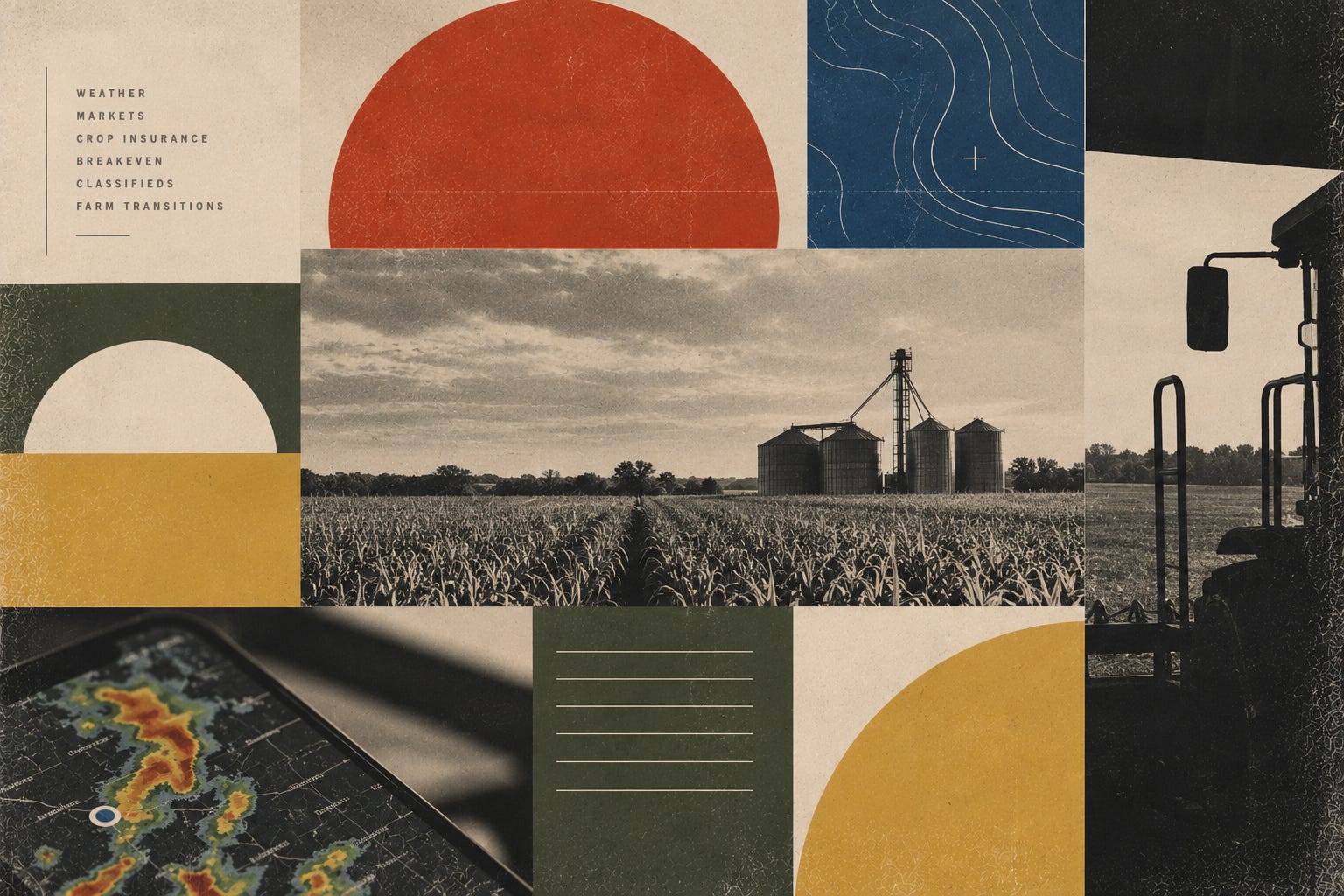
We unveiled the app on a Tuesday night at the Farm Progress Show, from the John Deere booth, after the gates had closed and the crowds had thinned out.
I’ll admit we hammed it up. We threw a party on Wednesday night and ran it like an Apple keynote, put it out live on Facebook and TikTok, and stood up there walking through features for people who’d been on their feet in the sun all day. It felt a little ridiculous and it also felt right, because the thing we were showing them was built almost entirely out of what they’d told us.
The question that started it
Why should a farmer need 20 different apps to get through the day?
One app for radar. Another for futures. Another for local cash bids. A spreadsheet back at the office for breakeven. A bookmark somewhere for crop insurance dates. Nothing talks to anything else, and every one of those companies wants to own a piece of your phone.
Any one of them is minor. Stacked across a season they add up, and farming already hands you plenty of that.
What we kept hearing
I didn’t keep a formal list. I just noticed the same complaints coming up enough times that I couldn’t pretend they were one-offs.
The radar apps are cluttered and slow, and half the screen is an ad for car insurance. A guy standing in the shop at 5:30 trying to decide whether he can spray today doesn’t need a commercial between him and the answer.
Markets and cash bids live in separate places, so that’s two apps to answer one question.
The breakeven math sits on the office computer, which does you exactly no good when you’re standing at the back of a sale barn with a bidder card in your hand.
Crop insurance dates get published for everybody. Nobody wants to scroll a national list to find the three that apply to their county.
And underneath all of it, the one I heard most: I’ve got too many apps.
Our audience has always picked the topics
I want to be clear about where this came from, because it didn’t start in a product meeting.
Farm4Profit Media has run on listener feedback since 2020. When the derecho came through Iowa that August, we threw out the schedule and made episodes to answer what people were actually asking us. Crop insurance adjusters. Short-term grain storage. Pastors and mental health folks, because that part was real too. We did it because the texts and messages told us to.
That changed how I think about this business. Before it, honestly, a lot of what I was doing was trying to look like the sharpest banker in central Iowa. After it, the question got simpler. What do farmers need?
The answers have been arriving ever since, through texts, DMs, emails, and a whole lot of conversations in booths and parking lots. The app is just the next thing on that list.
What we built, and why each piece is in there
The rule we gave ourselves was that we had to want to use it ourselves. If nobody on our team would open it on a Tuesday morning, it didn’t go in.
The radar is high resolution, single site, with the full National Weather Service warning text and the Storm Prediction Center outlooks. No ads sitting on top of it.
There’s a spray window showing wind, humidity, inversion risk, and how long you’ve got before rain. That came straight from guys doing that math in their head at daylight.
Rainfall is radar estimated for your location and checked against nearby physical gauges, because radar on its own will lie to you and everybody knows it. A seven-day crop water balance runs alongside it.
Markets are grain and livestock futures plus local cash bids, in one place.
Crop insurance dates are filtered to your county. Just yours.
Classifieds are free and limited to verified members. I wouldn’t have come up with that one. It came from listeners who wanted somewhere to buy and sell without wading through scammers. The Land & Legacy farm transition listings run in there too.
The banker part of my brain
Fifteen years in ag lending left me with a reflex I can’t shake, which is running numbers before anybody asks for them.
Back then I did something I called Banker on the Bench. If 40 acres were coming up at auction, I’d run the down payment and the annual payment at $10,000 an acre, $12,000, $15,000, and have it sitting on my desk before the farmer called. Nobody should have to do that math standing in a crowd.
So the app has a breakeven calculator that can pull live prices, plus land rent and GDU calculators. Same tool, different filing cabinet.
A calculator on a phone doesn’t replace a conversation with your accountant or your lender. But a lot of decisions get made before that conversation ever happens, and I’d rather they get made with a number attached.
Free, and staying that way
No paywalls, no ads in the radar.
I know how that sounds from a company with profit in its name. We’ve never charged our audience for anything, and the reason partnerships with John Deere, Corteva, Sukup, Brandt, Ag Leader, and AgXplore work is that the audience trusts us. Putting a toll booth in front of a radar screen is a quick way to spend that down.
The podcast’s in there too, full episodes, the show schedule, and a direct line to message the crew.
Tell us what’s missing
What we launched in September is version one, and we’ve said from the start that we’ll keep building it around how farmers actually use it.
So use the help and feedback button. I mean that the same way I meant it in 2020. We already know we missed things, and some of them are probably obvious to you and invisible to me. If you open it up and your first thought is “it should do this,” that’s the message I want.
You can download it on the App Store. Then tell me what to fix.